















Dr. Rahul Maity 
५/३०/२०२६, ६:३१:१० पू (5/30/2026, 6:31:10 AM)
This legendary verse is universally recognized as the words of Bhagavān Śrī Rāma addressed to Lakṣmaṇa after the conquest of Lanka.
In the Indian Knowledge System, this verse encapsulates राष्ट्रधर्मः (National Duty) and मातृतत्त्वम् (The Principle of Motherhood). It contrasts material opulence with spiritual and cultural roots.
The Concept of the Earth as Mother: In ancient Indian geopolitical thought, a nation is not merely a piece of land, a political boundary, or an economic zone. It is a living, nurturing entity. This echoes the famous Atharva Veda declaration (12.1.12): "Mātā bhūmiḥ putro ahaṃ pṛthivyāḥ" (The Earth is the mother, and the human is her child). Giving the motherland the exact same reverential status as the biological mother (Jananī) is a uniquely Indian philosophical construct.
Dharma vs. Material Wealth: Laṅkā symbolizes absolute, intoxicating material wealth and extreme economic development (Svarṇamayī - made of gold).
Ayodhyā represents duty, cultural roots, and Dharma. By rejecting the "Golden City" in favor of returning to the homeland, the concept teaches that sheer economic luxury should never overwrite loyalty to one's roots. True identity is tied to heritage, not real estate.
Modern Relevance -
Traveling the globe, pursuing education, and building successful careers in foreign lands are phenomenal achievements. However, living in a "Golden City" does not mean severing ties with cultural roots. True global citizens absorb the best of the world while maintaining an unbreakable emotional and spiritual bond with their heritage. No matter how successful one becomes abroad, the values, culture, and wisdom of the motherland remain the true north. Stay global, but keep the roots deeply Indian!
#drrahulmaity #Sanskritayanam #IndianKnowledgeSystem #Sanskrit #AncientWisdom #Motherland #Ramayana #CulturalRoots #Subhashita #Patriotism #GlobalIndian #NRIKids #Heritage
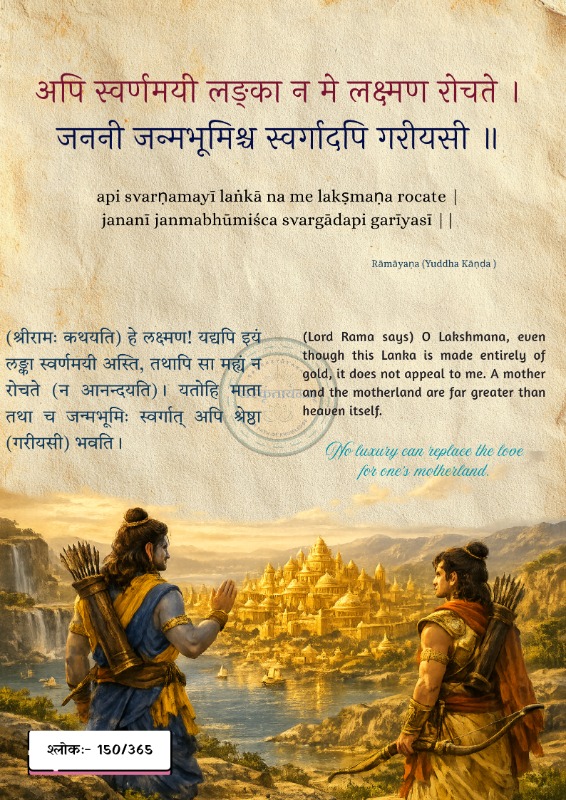
In the Indian Knowledge System, this verse encapsulates राष्ट्रधर्मः (National Duty) and मातृतत्त्वम् (The Principle of Motherhood). It contrasts material opulence with spiritual and cultural roots.
The Concept of the Earth as Mother: In ancient Indian geopolitical thought, a nation is not merely a piece of land, a political boundary, or an economic zone. It is a living, nurturing entity. This echoes the famous Atharva Veda declaration (12.1.12): "Mātā bhūmiḥ putro ahaṃ pṛthivyāḥ" (The Earth is the mother, and the human is her child). Giving the motherland the exact same reverential status as the biological mother (Jananī) is a uniquely Indian philosophical construct.
Dharma vs. Material Wealth: Laṅkā symbolizes absolute, intoxicating material wealth and extreme economic development (Svarṇamayī - made of gold).
Ayodhyā represents duty, cultural roots, and Dharma. By rejecting the "Golden City" in favor of returning to the homeland, the concept teaches that sheer economic luxury should never overwrite loyalty to one's roots. True identity is tied to heritage, not real estate.
Modern Relevance -
Traveling the globe, pursuing education, and building successful careers in foreign lands are phenomenal achievements. However, living in a "Golden City" does not mean severing ties with cultural roots. True global citizens absorb the best of the world while maintaining an unbreakable emotional and spiritual bond with their heritage. No matter how successful one becomes abroad, the values, culture, and wisdom of the motherland remain the true north. Stay global, but keep the roots deeply Indian!
#drrahulmaity #Sanskritayanam #IndianKnowledgeSystem #Sanskrit #AncientWisdom #Motherland #Ramayana #CulturalRoots #Subhashita #Patriotism #GlobalIndian #NRIKids #Heritage
 २४
२४ 
 ३.४ सह.
 2 comments
चञ्चलः
५/३०/२०२६, ६:४४:४५ पू (5/30/2026, 6:44:45 AM)
जननी जन्मभूमिः च स्वर्गादपि गरीयसी


Prema Shree
५/३०/२०२६, ८:४२:५० पू (5/30/2026, 8:42:50 AM)
जननी जन्मभूमिः च स्वर्गादपि गरीयसी!
